
The engagement model
How we work.
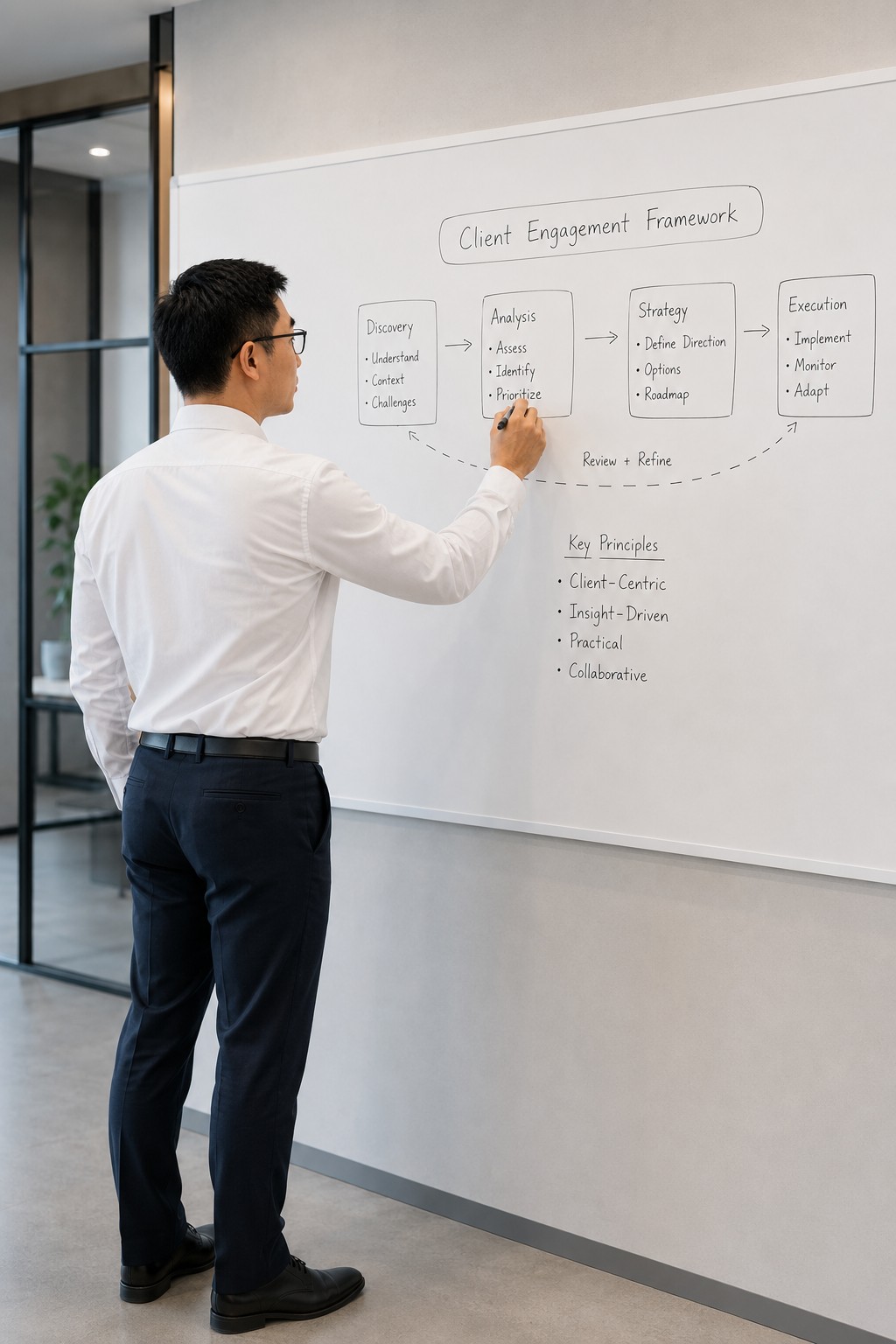
A clear process from first conversation to working solution, with the same people throughout.
We do not automate chaos. We eliminate it first. Every situation is different. We adapt to the business, not the methodology.

The engagement process
The engagement process.
This isn't a linear project plan. It's a working partnership that deepens over time.
Phase 01
Decision-maker conversation
We start with a focused conversation with the person accountable for outcomes.
Phase 02
Improvement diagnostic
If there's potential fit, we look at how the business actually runs - examining workflows, handoffs, decision patterns, and dependencies.
Phase 03
Ongoing execution partnership
We work alongside you to implement changes and stay until the results are proven in day-to-day operations.
REAL EXECUTION PROBLEMS
These are the patterns that show up most often.
Founder bottleneck: Key decisions still run through one person. The owner is the process.
Staff dependency: Customers tied to individual staff members, not the business itself. When key people leave, customers leave.
Invisible customer flow: Inquiries come in across multiple channels but go nowhere - no capture, no consistency, no data. The owner answers manually. You have no idea which channels actually work.
Growth outpacing operations: The model that got you here won't get you further. But there's no clear path to what needs to change.

CONFIDENTIALITY
Your situation stays between us.
This work involves sensitive operational and organisational information.
We work discreetly with decision-makers. All conversations and diagnostics are treated as confidential, and we address it upfront, not as an afterthought.
All diagnostics, business information, and internal documents shared with us remain strictly between Morvix Partners and the decision-maker. We do not discuss client situations with any third party without explicit consent.
MINIMUM ENGAGEMENT
Six months.
Execution takes time. Anything shorter rarely creates change that holds.
Why six months?
- · Root causes take time to surface, not just symptoms.
- · Meaningful changes need implementation cycles, not just planning.
- · Improvements need to be tested under real pressure, not just in theory.
- · The business needs time to absorb changes, not just receive them.

Earned leverage
Automation and AI are outcomes, not starting points.
The right tool works. But only when the foundations are already solid.
What founders expect automation to fix
- · Slow decisions
- · Coordination overhead
- · Founder bottlenecks
- · Inconsistent execution
What actually needs fixing first
- · Unclear ownership
- · Missing decision rules
- · Undefined handoffs
- · Reactive workflows
We do not automate chaos. We eliminate it first.
Ready to see how we work in practice?
Our frameworks are built from real execution work, released when the pattern is clear and the approach is proven.